Studying requires more than simply sitting with a book or opening a laptop. To learn effectively, students need to give their full attention to the material, understand important concepts, practice what they have learned, and review information regularly. However, staying focused can be difficult when phones, social media, television, conversations, household responsibilities, notifications, and even personal thoughts compete for attention.
Distractions are a normal part of modern student life. The goal is not to eliminate every possible distraction, because that is often impossible. Instead, successful students learn how to control their environment, organize their study sessions, manage digital devices, and train themselves to return to the task whenever their attention wanders.
Recent guidance on digital distraction emphasizes reducing notifications, creating a dedicated study environment, and avoiding multitasking.
This article explains practical ways to avoid distractions and stay focused while studying, whether you are preparing for school exams, university assignments, professional courses, or competitive tests.
Why Do Students Get Distracted While Studying?
Before learning how to avoid distractions, it is useful to understand why they happen.
One major reason is that studying often provides delayed rewards. You may spend an hour reading a difficult chapter before seeing any obvious result. By comparison, checking social media, watching a short video, or replying to a message provides immediate stimulation.
Distractions can also come from the study environment. A noisy room, television, conversations, an uncomfortable chair, or a cluttered desk can repeatedly pull your attention away.
There are also internal distractions. You may start thinking about an upcoming exam, a conversation with a friend, household responsibilities, money, future plans, or something you need to do later. Even when your phone is switched off, these thoughts can interrupt concentration.
Understanding these causes is important because different distractions require different solutions.
1. Create a Dedicated Study Space
One of the easiest ways to improve concentration is to create a specific place for studying.
Your study space does not need to be large or expensive. A small desk, a chair, and a quiet corner can be enough. The important thing is to make the area associated with studying rather than entertainment.
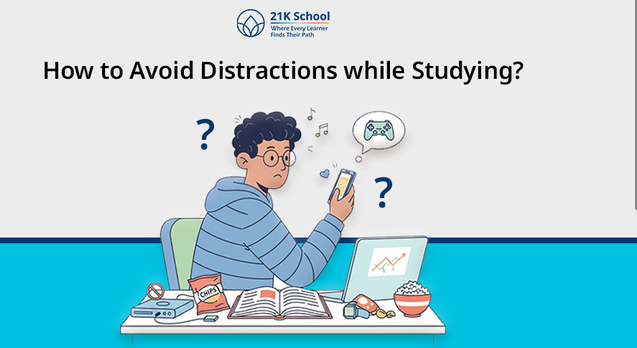
Keep unnecessary objects away from your desk. Remove gaming controllers, unrelated books, excessive decorations, food wrappers, and anything else that repeatedly catches your attention.
If possible, avoid studying in bed. Beds are strongly associated with relaxation and sleep, so they may make it harder to maintain an alert and productive state.
A consistent study location can also help create a routine. When you repeatedly use the same place for focused work, sitting there can become a signal that it is time to study.
2. Keep Your Phone Away
For many students, the smartphone is one of the biggest sources of distraction.
A phone can provide messages, social media, videos, games, news, shopping, and countless other activities. Even when you intend to check it for only a few seconds, one notification can lead to several minutes of unrelated activity.
The simplest solution is to create physical distance.
Put your phone in another room, inside a drawer, or somewhere that requires effort to reach. If you need it for an educational task, activate Focus Mode or Do Not Disturb and disable unnecessary notifications.
University guidance on digital distraction recommends turning off notifications and making distracting apps harder to access.
Do not depend entirely on willpower. Make distraction inconvenient instead.
3. Turn Off Unnecessary Notifications
Notifications are designed to attract attention. A message preview, sound, vibration, or pop-up can interrupt your thought process even if you do not respond.
Before beginning a study session, turn off notifications for:
- Social media apps
- Shopping applications
- News apps
- Entertainment platforms
- Games
- Promotional emails
- Non-essential messaging groups
Keep only genuinely important notifications if necessary.
You can also schedule specific periods when notifications are allowed. This creates a clear separation between study time and communication time.
Instead of checking messages every few minutes, decide to check them during a planned break.
4. Set a Clear Study Goal Before Starting
One common reason students lose focus is that they start studying without knowing exactly what they want to accomplish.
Saying, “I am going to study biology,” is vague.
A better goal would be:
“I will study Chapter 4, make notes on the three main concepts, and complete 15 practice questions.”
A specific goal gives your study session direction.
Before sitting down, write two or three tasks you want to complete. Keep the list realistic. If you create an enormous list, you may become overwhelmed and lose motivation.
Clear goals reduce the time you spend deciding what to do next.
5. Break Large Tasks Into Smaller Tasks
Large assignments can feel intimidating.
For example, “prepare for the final exam” sounds enormous. Instead, divide the work into smaller objectives:
- Review Chapter 1.
- Make a summary.
- Memorize key definitions.
- Solve practice questions.
- Review mistakes.
- Move to Chapter 2.
Breaking a large goal into smaller tasks makes studying feel more manageable.
It also gives you frequent opportunities to recognize progress, which can increase motivation.
6. Use Time Blocks for Focused Study
Instead of sitting at your desk for several hours without a plan, divide your study time into focused blocks.
One popular approach is the Pomodoro-style method:
- Study for 25 minutes.
- Take a 5-minute break.
- Repeat the cycle.
- After several cycles, take a longer break.
However, 25 minutes is not a strict requirement. Some students prefer 30, 45, or 50-minute study periods followed by a short break.
The best duration depends on your concentration level and the difficulty of the subject.
The main idea is to create a defined period during which you commit to one task without unnecessary interruptions. Structured study sessions are commonly recommended as a way to make concentration more manageable.
7. Avoid Multitasking
Multitasking may feel productive, but constantly switching between tasks can make studying less efficient.
For example, you might try to:
- Read a textbook.
- Answer messages.
- Watch a lecture.
- Listen to music.
- Check email.
- Browse social media.
Although you may feel busy, your attention is divided.
Instead, practice monotasking. Choose one activity and focus on it.
If you are reading, read. If you are solving mathematics problems, solve them. If you are writing an assignment, write it.
Complete one meaningful task before switching to another.
8. Use the “Distraction List” Technique
Sometimes distractions come from your own thoughts.
You may suddenly remember that you need to send an email, buy something, call someone, search for information, or complete another assignment.
Instead of immediately acting on the thought, write it down.
Keep a small notebook beside you and create a “later” list.
For example:
Things to handle later:
- Reply to my friend.
- Search for a new laptop.
- Call the teacher.
- Check tomorrow’s schedule.
- Buy stationery.
Once the thought is written down, return to studying.
This technique prevents you from constantly switching tasks while also giving you confidence that you will not forget the important thought.
9. Keep Your Study Desk Organized
A messy environment can make studying more difficult.
Before beginning a session, spend a few minutes preparing your workspace. Keep only the materials you need for the current task.
For example, if you are studying mathematics, you may only need:
- Mathematics book
- Notebook
- Calculator
- Pens
- Water
Everything else can be moved away.
An organized workspace reduces unnecessary visual distractions and makes it easier to begin working immediately.
10. Choose the Right Time to Study
Everyone has different periods during the day when they feel more alert.
Some students concentrate best early in the morning. Others work better in the afternoon or evening.
Pay attention to your energy levels for several days.
Ask yourself:
- When do I feel most awake?
- When can I concentrate without feeling sleepy?
- When is my home environment quietest?
- When am I least likely to receive interruptions?
Schedule difficult subjects during your strongest concentration periods whenever possible.
Establishing a consistent study routine can make it easier to develop productive habits.
11. Control Noise and Other Environmental Distractions
Noise can make concentration difficult, especially when studying at home.
If possible, choose a quiet room. Close the door and inform family members that you need uninterrupted study time.
If complete silence is impossible, consider using:
- Earplugs
- Noise-cancelling headphones
- Low-volume background sounds
- Instrumental music
- Nature sounds
- White or brown noise
Avoid music with distracting lyrics if you notice that you start paying attention to the words instead of your studies.
Experiment to discover which environment helps you concentrate best.
12. Tell Family Members About Your Study Schedule
Students who study at home may face frequent interruptions from family members.
Instead of becoming frustrated every time someone interrupts you, communicate your schedule clearly.
For example, you could say:
“I am studying from 7:00 PM to 8:30 PM. Please let me work without interruptions unless something is urgent.”
You can also place a simple note on your door or establish specific quiet hours.
When family members know your schedule, they are more likely to understand when you need uninterrupted time.
13. Avoid Social Media During Study Breaks
Breaks are important, but the type of break matters.
If you spend a five-minute break scrolling through social media, you may find it difficult to return to your books.
Short-form videos and social media can quickly turn a short break into a much longer interruption.
Instead, use breaks for activities such as:
- Walking around
- Stretching
- Drinking water
- Looking outside
- Taking a few deep breaths
- Preparing your next study task
- Having a light snack
The goal of a break is to refresh your mind rather than completely change your attention to another highly stimulating activity.
14. Take Regular Breaks
Trying to study continuously for many hours can lead to mental fatigue.
Regular breaks allow you to step away from demanding mental work and return with renewed attention.
A break does not mean wasting time. It is part of an effective study system.
For example, after two or three focused study blocks, take a longer break. Stand up, move around, drink water, and give yourself some time away from your study materials.
The ideal schedule varies from student to student, so experiment with different study and break lengths.
15. Get Enough Sleep
Sleep plays an important role in learning, memory, energy, and concentration.
If you regularly study late into the night and sleep very little, you may spend more time studying but remember less of what you studied.
Instead of sacrificing sleep for endless study hours, create a realistic schedule that includes adequate rest.
Try to maintain a consistent sleeping routine. Avoid turning every night before an exam into an all-night study session.
A well-rested student can often study more effectively than a tired student who spends twice as many hours at a desk.
16. Eat and Drink Properly
Hunger and dehydration can make it harder to remain comfortable and attentive.
Keep water available while studying. Eat balanced meals and choose practical snacks when you need something between meals.
Avoid relying heavily on sugary drinks or excessive caffeine to force yourself through long study sessions.
Your goal should be to maintain steady energy rather than repeatedly experiencing sharp increases and decreases in alertness.
17. Start With the Most Difficult Task
Many students spend their most productive hours on easy activities and leave difficult subjects until they are already tired.
Consider doing the hardest task earlier in your study session when your mental energy is higher.
For example, if mathematics is your most challenging subject, study mathematics before moving to easier reading or revision.
Once the difficult task is completed, the rest of the session may feel easier.
18. Make Studying Active
Passive studying can make it easier for your mind to wander.
Instead of simply reading the same pages repeatedly, actively engage with the material.
Try:
- Writing your own notes
- Answering practice questions
- Explaining concepts aloud
- Creating flashcards
- Solving problems
- Teaching a topic to someone else
- Summarizing a chapter from memory
Active learning gives your brain a specific job to perform.
It can also make difficult subjects more interesting and reduce boredom.
19. Reward Yourself After Completing Tasks
Small rewards can make long study periods feel more manageable.
For example, after completing a specific goal, you might:
- Watch one episode of a show
- Talk with friends
- Play a game
- Have a favorite snack
- Go for a short walk
- Spend some time on social media
The important point is to make the reward dependent on completing the planned task.
For example:
“After I complete 20 practice questions, I will take a 20-minute break.”
This gives you something enjoyable to look forward to while keeping your study goal clear.
20. Do Not Wait for Motivation
One of the biggest mistakes students make is waiting until they feel motivated before studying.
Motivation is not always present.
There will be days when you feel energetic and interested. There will also be days when studying feels boring or difficult.
Instead of waiting for motivation, rely on a routine.
Tell yourself that you only need to study for the first 10 or 15 minutes. Once you begin, continuing is often easier than starting.
Consistency is usually more valuable than occasional periods of extreme motivation.
21. Use Website and App Blockers When Necessary
If you repeatedly lose study time to websites or applications, use technology to protect your attention.
Website blockers and focus applications can temporarily restrict access to distracting websites.
You can block:
- Social media
- Video platforms
- Online games
- Entertainment websites
- Shopping sites
- News feeds
Set the blocker for your planned study period.
This creates an additional barrier between you and the distraction.
22. Keep Your Computer Focused on Study
Computers are useful for education but can also contain hundreds of distractions.
Create a separate study profile or browser environment if possible.
Keep your study tabs open and close unrelated websites.
For online classes, avoid opening social media or entertainment websites in other tabs.
If you need to research something, write down unrelated questions instead of immediately searching for them.
This keeps your online study session focused.
23. Learn to Return to Focus
Even with the best system, you will sometimes become distracted.
Do not think that one distraction means your entire study session is ruined.
If you notice that you have been scrolling through your phone for ten minutes, simply stop.
Do not spend another 20 minutes feeling guilty.
Take a breath, put the phone away, look at your study goal, and continue.
The ability to return to the task is one of the most important focus skills you can develop.
24. Track Your Progress
Keeping track of your study sessions can help you understand your habits.
At the end of each day, write down:
- How long you studied
- What subjects you covered
- What distracted you
- Which strategy worked
- What you want to improve tomorrow
After a week, you may notice patterns.
For example, you may discover that your concentration is strongest in the morning or that your phone causes most of your interruptions.
Once you know the cause, you can adjust your routine.
25. Create a Simple Daily Study Routine
A consistent routine can make studying easier because you spend less time deciding when and how to begin.
A simple routine might look like this:
Morning
- Review important notes.
- Complete the hardest subject.
- Take a short break.
Afternoon
- Attend classes or complete assignments.
- Practice questions.
- Review difficult concepts.
Evening
- Revise what you learned.
- Prepare tasks for tomorrow.
- Organize study materials.
You do not need to copy this exact routine. Build a schedule around your school, university, job, family responsibilities, and personal energy levels.
Common Mistakes That Reduce Study Focus
Avoiding distractions is not only about adding good habits. It is also about removing habits that repeatedly damage concentration.
Common mistakes include:
Studying With Your Phone Beside You
Even if you promise not to use it, having it within easy reach creates temptation.
Studying Without a Goal
Opening a book without knowing what you want to accomplish often leads to passive reading.
Studying for Extremely Long Periods
Long sessions without breaks can lead to fatigue and declining attention.
Multitasking
Switching between subjects, messages, videos, and websites makes it harder to maintain deep concentration.
Sacrificing Sleep
Studying late every night may reduce the quality of your learning and leave you exhausted.
Using Social Media as a Break
A five-minute social media break can easily become thirty minutes.
Expecting Perfect Focus
Nobody maintains perfect concentration throughout every study session. The goal is to reduce unnecessary distractions and return to the task when your attention wanders.
A Practical Focus Routine for Students
If you are unsure where to begin, try this simple routine:
Step 1: Choose one specific study goal.
Step 2: Clean your study area.
Step 3: Put your phone away.
Step 4: Turn off unnecessary notifications.
Step 5: Prepare your books, notes, and stationery.
Step 6: Set a timer for a focused study block.
Step 7: Work on one task only.
Step 8: Write down distracting thoughts instead of acting on them.
Step 9: Take a short break when the study block ends.
Step 10: Repeat the process.
Step 11: Review what you accomplished.
Step 12: Prepare the next day’s study goals.
This system is simple, but its effectiveness comes from consistency.
Final Thoughts
Learning how to avoid distractions and stay focused while studying is a skill that improves with practice. You do not need extraordinary concentration or unlimited motivation. You need a study environment and routine that make focused work easier.
Start by removing obvious distractions, especially unnecessary phone notifications and social media. Create a dedicated study space, set clear goals, divide large assignments into smaller tasks, and use focused study blocks with regular breaks. At the same time, take care of your sleep, food, water, and overall daily routine.
Most importantly, do not expect yourself to remain perfectly focused every minute. Distractions will happen. What matters is how quickly you recognize them and return to your work.