Studying for long hours does not always mean learning more. Many students spend several hours reading textbooks, reviewing notes, or watching lectures but still struggle to remember what they studied. The difference often comes down to how you study, not simply how much time you spend.
Effective studying requires concentration, active participation, good planning, and techniques that help your brain understand and remember information. Research-based learning strategies such as retrieval practice, spaced study, self-explanation, and reducing distractions can make study sessions more productive.
Whether you are preparing for school exams, college assignments, professional certifications, or learning a new skill, improving your study habits can help you make better use of your time.
In this article, we will explore 10 effective study tips to improve focus and learn faster, along with practical ways to incorporate them into your daily routine.
Why Effective Study Techniques Matter
Before discussing individual study tips, it is important to understand why traditional studying does not always produce good results.
Many students rely heavily on rereading chapters, highlighting large sections of textbooks, or studying everything the night before an exam. These activities can make information look familiar without necessarily helping you retrieve it later. Learning strategies that require you to actively recall, explain, organize, and apply information can produce stronger learning.
Effective study habits can help you:
- Improve concentration
- Remember information for longer
- Understand difficult concepts
- Reduce wasted study time
- Prepare more effectively for exams
- Build confidence
- Reduce last-minute stress
- Balance studying with other responsibilities
The goal is not to study every waking hour. The goal is to make your study time more productive.
1. Set a Clear Goal Before Every Study Session
One of the simplest ways to improve focus is to know exactly what you want to accomplish before you begin.
Instead of saying, “I need to study chemistry,” create a specific goal such as:
- Complete two chapters of chemistry
- Learn 20 vocabulary words
- Solve 15 algebra problems
- Review the causes of World War I
- Create flashcards for biology terms
- Practice three essay questions
A vague goal makes it easier to procrastinate because you do not have a clear starting point. A specific goal gives your brain a defined task.
How to Set Better Study Goals
At the beginning of each session, write down one to three tasks you want to complete. Make them realistic enough to finish within your available time.
For example:
Poor goal:
Study mathematics.
Better goal:
Review quadratic equations for 30 minutes and solve 15 practice problems.
Breaking large assignments into smaller tasks can make studying feel less overwhelming. Planning resources also recommend setting specific and measurable study goals rather than approaching study time without a defined purpose.
2. Create a Distraction-Free Study Environment
Your environment has a major effect on your ability to concentrate. Phones, social media, television, unnecessary notifications, conversations, and noisy surroundings can interrupt your attention.
Even if you believe you can ignore distractions, frequent interruptions can make it harder to maintain deep concentration.
A focused study environment should contain the things you actually need and as few unnecessary distractions as possible.
How to Create a Better Study Space
Before studying:
- Put your phone on silent or leave it away from your desk.
- Turn off unnecessary notifications.
- Close unrelated browser tabs.
- Keep only essential books and materials nearby.
- Choose a quiet location.
- Keep water nearby.
- Tell family or friends when you need uninterrupted study time.
- Keep your desk clean and organized.
If your home is noisy, consider using a library, study room, or another quiet location.
Academic guidance on improving focus similarly recommends controlling environmental distractions and choosing a quieter study space when possible.
The goal is to make focusing easier instead of constantly fighting against distractions.
3. Use Active Recall Instead of Simply Rereading
Active recall is one of the most useful techniques for improving learning and memory.
Instead of repeatedly reading the same information, close your book and try to remember what you just learned.
For example, after reading a section about photosynthesis, close your textbook and ask yourself:
- What is photosynthesis?
- Where does it occur?
- What are its main stages?
- What materials are required?
- What products are produced?
Try answering without looking at your notes. Then check your answers and identify what you missed.
Practical Ways to Use Active Recall
You can use active recall by:
- Creating flashcards
- Taking practice quizzes
- Answering textbook questions
- Writing information from memory
- Explaining a topic aloud
- Creating your own questions
- Completing practice tests
- Summarizing a chapter without looking at it
Research on learning consistently highlights retrieval practice as a powerful approach because it requires the brain to retrieve information rather than simply recognize familiar words.
The important part is to attempt recall before checking the answer.
4. Study in Focused Time Blocks
Trying to study continuously for several hours can eventually lead to mental fatigue. Instead, divide your study time into manageable blocks.
For example, you might study for 25–50 minutes and then take a short break.
A simple approach is:
25 minutes: Focused studying
5 minutes: Short break
25 minutes: Focused studying
5 minutes: Short break
25 minutes: Focused studying
15–30 minutes: Longer break
The exact timing does not have to be identical for everyone. Some students may prefer 30-minute sessions, while others can comfortably focus for 50 or 60 minutes.
What to Do During Breaks
Use breaks to:
- Stand up
- Stretch
- Drink water
- Walk around
- Rest your eyes
- Take a few deep breaths
Try not to spend every break scrolling through social media. A five-minute break can easily turn into thirty minutes if you become absorbed in your phone.
Short, focused study sessions combined with meaningful breaks can help you maintain attention and avoid unnecessary mental fatigue.
5. Use Spaced Repetition Instead of Cramming
One of the biggest mistakes students make is waiting until the last day before an exam to review everything.
Cramming can sometimes help you remember information for a very short period, but it is not an ideal strategy for long-term retention.
Spaced repetition involves reviewing information multiple times with increasing gaps between study sessions.
For example, instead of studying a topic for three hours on Sunday, you could review it for shorter periods across several days.
A simple schedule might look like:
Day 1: Learn the material
Day 2: Quick review
Day 4: Test yourself
Day 7: Review again
Day 14: Practice recall
The exact schedule can vary depending on the subject and how difficult the material is.
Research-based study guidance emphasizes that spacing retrieval across time can improve long-term retention compared with repeatedly studying the same information in one concentrated session.
Why Spacing Works
When you return to information after some time has passed, your brain has to work harder to retrieve it. That effort can strengthen your ability to remember the information later.
Instead of asking, “How many hours can I study today?” ask:
“How can I revisit this material several times before my exam?”
6. Explain Difficult Concepts in Your Own Words
If you cannot explain something simply, you may not understand it as well as you think.
One effective strategy is to explain a concept using your own words as though you were teaching it to someone who knows nothing about the subject.
For example, after learning about the water cycle, close your textbook and explain:
“Water evaporates because of heat from the sun. It rises into the atmosphere, cools, and forms clouds. Eventually, water returns to the Earth’s surface through precipitation.”
If you get stuck, that is useful information. It shows you exactly where your understanding is incomplete.
Try the Teach-Back Method
Follow these steps:
- Choose a topic.
- Study it carefully.
- Close your notes.
- Explain it using simple language.
- Identify anything you cannot explain.
- Review that section.
- Explain it again.
Self-explanation is recommended as an active learning strategy because putting information into your own words forces you to process the material rather than simply recognize it.
7. Combine Notes With Visuals and Examples
Some subjects become easier to understand when information is presented visually.
Instead of writing pages of notes, try turning important information into:
- Mind maps
- Flowcharts
- Diagrams
- Timelines
- Tables
- Concept maps
- Labeled illustrations
For example, if you are studying the digestive system, a labeled diagram can help you understand the sequence of organs and processes better than a page of text alone.
Dual coding—combining words with meaningful visuals—is one of the study strategies highlighted by academic learning resources.
Use Examples to Strengthen Understanding
Whenever possible, connect an abstract concept to a real-world example.
For mathematics, solve practical problems.
For economics, connect theories to everyday situations.
For biology, relate concepts to real organisms.
For computer science, practice concepts by writing code.
For language learning, use new vocabulary in sentences.
Examples make information easier to understand and provide additional connections that may help you remember it.
8. Practice With Questions and Problems
Reading about a subject is not the same as being able to use it.
This is especially important for subjects such as mathematics, physics, chemistry, accounting, programming, and other problem-solving disciplines.
After learning a concept, practice applying it.
For example, if you are studying mathematics, do not spend your entire session reading formulas. Solve problems without immediately looking at the solution.
If you are studying a language, do not only memorize vocabulary. Use the words in sentences.
If you are preparing for an exam, practice answering questions under conditions similar to the real test.
Learn From Your Mistakes
When you get a question wrong, do not simply check the correct answer and move on.
Ask:
- Why was my answer wrong?
- Which step did I misunderstand?
- Did I forget a formula?
- Did I misread the question?
- Did I make a calculation mistake?
- What should I do differently next time?
Your mistakes can become a powerful learning tool when you analyze them carefully.
Practice questions and problems encourage active engagement with the material rather than passive reading.
9. Take Care of Your Energy, Sleep, and Breaks
Good study techniques are important, but your brain also needs physical and mental energy.
Trying to learn while extremely tired, hungry, dehydrated, or mentally exhausted can make concentration more difficult.
Develop basic habits that support productive study sessions.
Get Enough Sleep
Avoid making all-night study sessions a regular habit. Adequate sleep supports concentration, memory, and self-control, all of which are important for learning.
Instead of sacrificing sleep to study for several extra hours, try improving the efficiency of your study sessions during the day.
Stay Hydrated
Keep water available while studying. This can also prevent unnecessary interruptions because you do not have to repeatedly leave your study area.
Move Regularly
Long periods of sitting can make you feel tired and uncomfortable. Stand up, stretch, or take a short walk during breaks.
Study When You Are Most Alert
Some students concentrate best in the morning, while others prefer the afternoon or evening.
Pay attention to your energy patterns and schedule demanding subjects during the periods when you normally feel most alert.
10. Review Your Progress and Adjust Your Study Method
Not every study method works equally well for every student or every subject.
The key is to experiment, measure your results, and adjust your approach.
At the end of each week, ask yourself:
- What did I learn?
- Which subjects are still difficult?
- Which study technique worked best?
- Where did I waste time?
- How well can I recall older material?
- What should I change next week?
For example, you may discover that flashcards work extremely well for vocabulary but are less useful for solving mathematics problems. You might then use flashcards for definitions and practice problems for mathematics.
Study strategies should also match how you will eventually be assessed. Different subjects and assessment formats may require different approaches.
Common Study Mistakes to Avoid
Knowing what not to do can be just as important as knowing what to do.
Studying With Your Phone Beside You
Even if you do not actively use it, notifications and the temptation to check messages can interfere with concentration.
Keep your phone away whenever possible.
Rereading the Same Chapter Repeatedly
Rereading can create a feeling of familiarity, but familiarity does not always mean you can recall or apply the information later.
Use active recall and practice questions instead.
Highlighting Everything
Highlighting can be useful for identifying a few important points, but highlighting entire pages does not force you to retrieve or apply information.
Studying Only Before Exams
Leaving everything until the last minute creates unnecessary pressure.
Use spaced reviews throughout the weeks leading up to an exam.
Multitasking
Trying to study while watching videos, chatting with friends, checking social media, and responding to notifications divides your attention.
Focus on one meaningful task at a time.
How to Build a Daily Study Routine
You do not need a complicated schedule to start studying more effectively.
Here is a simple example:
Morning
30–45 minutes: Review previously learned material using active recall.
Afternoon
45–60 minutes: Learn a new topic.
10–15 minutes: Take a break.
30–45 minutes: Complete practice questions.
Evening
20–30 minutes: Review important concepts from the day.
10 minutes: Use flashcards or quiz yourself.
This routine can be adjusted according to your classes, work, family responsibilities, and personal energy levels.
The most important thing is consistency.
A Simple Study Session Formula
If you do not know where to start, use this five-step formula:
1. Prepare
Remove distractions and collect everything you need.
2. Set a goal
Decide exactly what you want to accomplish.
3. Learn
Read, watch, listen, or review the new material.
4. Retrieve
Close your notes and test yourself.
5. Review later
Return to the material after a gap and test yourself again.
This combination is more active than simply reading the same pages repeatedly.
Final Thoughts
Learning faster does not necessarily mean trying to force your brain to absorb information at a higher speed. It means using your study time intelligently.
The most effective approach combines focused attention, active recall, spaced repetition, practice, self-explanation, organized study sessions, and healthy routines. Research-based academic resources consistently emphasize active learning and retrieval over passive rereading alone.
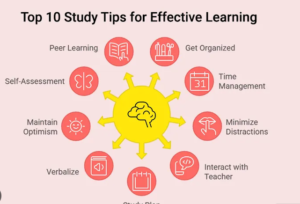
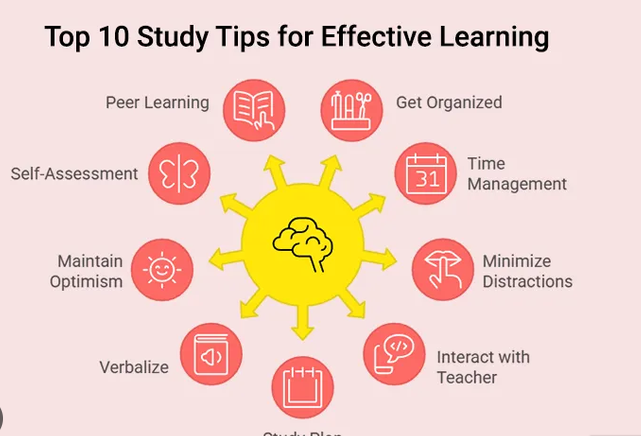
The 10 study tips covered in this article are:
- Set a clear goal before every study session.
- Create a distraction-free study environment.
- Use active recall instead of simply rereading.
- Study in focused time blocks.
- Use spaced repetition instead of cramming.
- Explain difficult concepts in your own words.
- Combine notes with visuals and examples.
- Practice with questions and problems.
- Take care of your energy, sleep, and breaks.
- Review your progress and adjust your study method.
You do not need to adopt all ten strategies at once. Start with two or three, practice them consistently, and gradually build a study routine that works for you.