Online learning has transformed the way students, professionals, and lifelong learners acquire knowledge. From university courses and professional certifications to short online classes and skill-based programs, learners can now study almost anywhere and at almost any time. This flexibility is one of the biggest advantages of online education, but it can also create challenges.
Without a traditional classroom, learners often have to manage their own schedules, avoid distractions, complete assignments on time, and remain motivated without constant supervision. Research on online learning has consistently highlighted the importance of motivation, self-regulation, time management, and effective learning strategies. Recent research also suggests that self-regulated learning strategies such as organization, metacognition, time management, and effort regulation are associated with better academic performance in online and blended environments.
The good news is that staying motivated and productive does not require extraordinary discipline. Instead, small and consistent habits can make online learning more manageable and enjoyable.
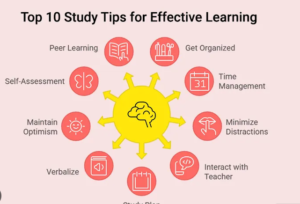
Below are 10 practical tips that can help students and working professionals stay focused, motivated, and productive while learning online.
1. Set Clear and Specific Learning Goals
One of the most effective ways to stay motivated is to know exactly what you want to achieve.
Simply saying, “I want to learn digital marketing,” “I want to improve my English,” or “I want to complete this course” may not be enough. Broad goals can feel overwhelming because they do not tell you what needs to be done today.
Instead, break your larger goal into smaller and measurable objectives.
For example, instead of:
“I want to complete my online course.”
Set a goal such as:
“I will complete two video lessons and one practical exercise by Friday.”
Specific goals provide direction and make progress easier to measure.
You can divide your learning goals into three levels:
Long-Term Goals
These describe what you want to accomplish over several months.
Examples include:
- Complete an online certification
- Learn a new professional skill
- Improve academic performance
- Prepare for an examination
- Develop skills for a career change
Monthly Goals
Break the long-term goal into smaller milestones.
For example, if your goal is to complete a six-month certification, determine which modules you should finish each month.
Daily Goals
Daily goals should be simple and realistic.
For example:
- Watch one lecture
- Read 10 pages
- Complete one assignment
- Practice 30 minutes
- Review yesterday’s notes
Small achievements create a sense of progress, which can make it easier to continue.
2. Create a Realistic Online Learning Schedule
Flexibility is one of the biggest benefits of online education, but too much flexibility can become a problem.
When there is no fixed classroom schedule, learners may repeatedly postpone lessons. A task that was supposed to be completed today can easily become tomorrow’s task, and eventually several unfinished lessons can accumulate.
Creating a consistent schedule solves this problem.
Choose specific times for learning and treat them like appointments.
For example:
| Time | Activity |
|---|---|
| 7:00–7:30 AM | Review notes |
| 6:00–7:00 PM | Watch course lessons |
| 7:00–7:15 PM | Take a break |
| 7:15–7:45 PM | Complete practice exercises |
Your schedule does not have to be complicated. The important thing is consistency.
Students can organize study sessions around their school or university timetable, while working professionals may choose early mornings, evenings, weekends, or lunch breaks.
A 2025 meta-analysis examining online and blended learning found that time management, effort regulation, organization, and metacognitive strategies were among the learning strategies associated with academic performance. This reinforces the importance of actively managing your learning time rather than relying on motivation alone.
3. Create a Dedicated Learning Environment
Your surroundings can strongly influence your ability to concentrate.
If you regularly study from your bed, sofa, or a noisy area, your brain may associate that environment with relaxation rather than focused learning.
Whenever possible, create a dedicated learning space.
Your study area should ideally have:
- A comfortable chair
- A suitable desk or table
- Good lighting
- Reliable internet
- Necessary books and materials
- Headphones if needed
- Minimal distractions
You do not need an expensive home office. Even a small corner of a room can become your regular learning area.
Try to keep unnecessary items away from your workspace. A clean and organized environment can make it easier to begin studying without spending time preparing your surroundings.
For working professionals, having a separate learning area can also create psychological separation between work, home responsibilities, and education.
4. Eliminate Digital Distractions
One of the biggest challenges of online learning is that the same device used for education also provides access to social media, entertainment, games, messaging apps, and other distractions.
You may open your laptop to watch a course lecture and suddenly find yourself checking notifications or browsing unrelated websites.
To protect your attention, reduce unnecessary digital distractions.
Try these strategies:
- Turn off non-essential notifications.
- Put your phone on silent or airplane mode.
- Close unnecessary browser tabs.
- Log out of social media during study sessions.
- Use website blockers when necessary.
- Keep only course-related applications open.
- Avoid checking messages during focused study periods.
You can also use the “single-tasking” approach.
Instead of trying to study while responding to messages, focus completely on the lesson for a specific period.
For example, study for 30–45 minutes without interruptions, then take a short break.
The goal is not to eliminate technology. The goal is to make technology work for your learning rather than against it.
5. Use Active Learning Instead of Passive Watching
Many online learners make the mistake of watching hours of lectures without actively interacting with the material.
Watching a video can feel productive, but simply consuming information does not guarantee that you understand or remember it.
Active learning requires you to interact with what you are studying.
Instead of only watching a lecture, try to:
- Take short notes.
- Write down important concepts.
- Pause the video and explain the idea in your own words.
- Create questions about the topic.
- Complete practice exercises.
- Solve problems without looking at the answer.
- Summarize the lesson after finishing it.
- Teach the concept to someone else.
For example, if you are learning accounting, do not simply watch a lecture about financial statements. Try creating a sample statement yourself.
If you are learning programming, write and test the code instead of only watching tutorials.
If you are studying a language, practice speaking and writing rather than only watching vocabulary videos.
Active participation turns learning from passive consumption into a practical experience.
6. Break Large Tasks Into Smaller Steps
Large assignments and difficult courses can quickly reduce motivation.
When a task appears too big, it is easy to think, “I will start later.”
Instead of looking at the entire project, divide it into smaller steps.
For example, suppose you need to write a 20-page assignment.
Instead of thinking:
“I have to write 20 pages.”
Break it down into:
- Choose the topic.
- Research the subject.
- Create an outline.
- Write the introduction.
- Complete the first section.
- Complete the second section.
- Review the content.
- Edit and proofread.
- Format the assignment.
- Submit the final version.
Each completed step gives you a sense of progress.
This approach is especially useful for working professionals who are balancing education with jobs, family responsibilities, and other commitments.
Small tasks are easier to start, and starting is often the hardest part.
7. Take Regular Breaks to Protect Your Focus
Studying continuously for several hours may not always be the most productive approach.
Your concentration can decline when you work for too long without a break. Short breaks can give your mind an opportunity to recover.
One simple approach is to study for 25–50 minutes and then take a short break.
During a break, you can:
- Walk around.
- Drink water.
- Stretch.
- Rest your eyes.
- Take a few deep breaths.
- Get some fresh air.
Try not to replace studying with another highly distracting activity. For example, opening social media during a five-minute break can easily turn into 30 minutes of scrolling.
Your breaks should help you return to learning with renewed attention.
It is also important to maintain a healthy balance between learning and rest. Productivity should not mean studying every available minute of the day.
8. Track Your Progress
Motivation becomes easier when you can see evidence that you are improving.
Online courses can sometimes feel endless because there are many lessons, assignments, quizzes, and modules. Tracking progress helps make the journey more visible.
You can use a simple notebook, calendar, spreadsheet, or digital task manager.
Track things such as:
- Lessons completed
- Assignments submitted
- Practice hours
- Quiz scores
- Chapters reviewed
- Skills learned
- Weekly study sessions
For example:
Week 1: 4 lessons completed
Week 2: 5 lessons completed
Week 3: 6 lessons completed
Seeing this progress can provide encouragement.
You can also celebrate small milestones.
When you complete a difficult module, finish an assignment, or reach the halfway point of a course, take a moment to recognize the achievement.
Progress does not always have to be measured by grades. Improved understanding, greater confidence, and newly developed skills are also valuable indicators.
9. Connect With Instructors and Other Learners
Online learning does not have to be a completely isolated experience.
Many learners lose motivation because they feel that they are studying alone. Interaction with instructors, classmates, mentors, or other learners can provide encouragement and accountability.
Whenever possible:
- Ask questions during live sessions.
- Participate in discussion forums.
- Join study groups.
- Communicate with instructors.
- Share ideas with classmates.
- Attend virtual workshops.
- Find a study partner.
- Discuss difficult concepts with others.
Social interaction can make learning more engaging.
Research on online courses has also identified interaction with instructors and peers, learning engagement, and perceived learning support as important factors related to learners’ perceived outcomes.
If you are a working professional, consider connecting with other professionals who are learning the same skill. You may discover useful resources, practical advice, and career opportunities through these connections.
10. Focus on Consistency Instead of Perfect Motivation
Perhaps the most important tip is to stop waiting for motivation.
You will not feel highly motivated every day.
Some days you will be excited to learn. On other days, you may feel tired, distracted, or uninterested.
If your entire learning routine depends on feeling motivated, it becomes difficult to maintain progress.
Instead, build a system that allows you to continue even when motivation is low.
For example, create a minimum daily target:
“I will study for at least 20 minutes every day.”
On a highly productive day, you might study for two hours. On a difficult day, you may only complete the 20-minute minimum.
Both are better than completely abandoning the routine.
Consistency creates momentum.
Over time, regular study sessions can become a habit rather than something that requires constant motivation.
How to Stay Motivated When You Feel Bored
Boredom is normal during online learning, especially when a course contains repetitive material.
If you feel bored, change your learning method.
Instead of watching another lecture, try:
- Creating a mind map
- Taking handwritten notes
- Solving practice questions
- Discussing the topic with someone
- Watching a practical demonstration
- Creating a small project
- Teaching the concept to another person
You can also connect the topic to your personal or professional goals.
For example, if you are learning Excel because you want a better job, remind yourself that each new skill is contributing toward that goal.
Understanding why you are learning something can make the learning process more meaningful.
What Working Professionals Can Do Differently
Working professionals face a unique challenge because online learning must fit around job responsibilities.
Instead of creating an unrealistic study schedule, identify your most reliable periods of free time.
For example, you may study:
- Before work
- During a lunch break
- After dinner
- During weekends
- During commute time, if the course supports audio learning
Avoid scheduling demanding study sessions when you are consistently exhausted.
You can also divide learning into different activities.
For example:
Weekdays: 30 minutes of reading or video lessons
Saturday: 2 hours of practical work
Sunday: Review and planning
This approach can make professional development more sustainable.
How Students Can Stay Productive During Online Classes
Students should prepare for online classes just as they would prepare for physical classes.
Before a class:
- Review the previous lesson.
- Prepare your notebook.
- Check your internet connection.
- Keep necessary materials nearby.
- Remove distractions.
During the class:
- Take notes.
- Participate when possible.
- Ask questions.
- Avoid unrelated browsing.
- Record important concepts.
After the class:
- Review your notes.
- Complete assigned exercises.
- Identify areas you do not understand.
- Prepare questions for the next session.
This three-stage approach—before, during, and after class—can make online learning more structured.
Common Mistakes That Reduce Online Learning Productivity
Even motivated learners can lose productivity because of poor habits.
Some common mistakes include:
Studying Without a Schedule
Without a defined routine, learning can easily be postponed.
Multitasking
Trying to study while watching videos, checking social media, and answering messages divides attention.
Setting Unrealistic Goals
Planning to study six hours every day when you realistically have only one or two available hours can quickly lead to frustration.
Watching Without Practicing
Understanding a concept theoretically is not the same as being able to use it.
Ignoring Difficult Topics
Avoiding challenging lessons usually creates bigger problems later.
Comparing Yourself With Other Learners
Everyone has different responsibilities, backgrounds, learning speeds, and schedules.
Focus on your own progress.
A Simple Daily Routine for Online Learning
A practical daily routine might look like this:
Step 1: Define one main learning goal.
Decide what you want to accomplish during the session.
Step 2: Prepare your environment.
Put your phone away, close unnecessary tabs, and prepare your materials.
Step 3: Study with full attention.
Work for 30–50 minutes without unnecessary interruptions.
Step 4: Take a short break.
Stand up, stretch, drink water, and rest your mind.
Step 5: Practice what you learned.
Complete an exercise, answer questions, or create something using the new knowledge.
Step 6: Review.
Spend a few minutes summarizing the most important points.
Step 7: Record your progress.
Mark the lesson or task as completed and decide what you will do next.
This routine is simple enough for students and working professionals while still providing structure.
Final Thoughts
Staying motivated and productive while learning online is less about studying for extremely long hours and more about building effective habits.
Clear goals give you direction. A realistic schedule provides structure. A dedicated learning environment reduces distractions. Active learning improves engagement, while regular breaks help maintain concentration. Tracking progress provides motivation, and interaction with instructors or other learners can make the experience more supportive.
Most importantly, do not expect yourself to feel motivated every day. Motivation naturally changes. A sustainable online learning routine should allow you to continue making progress even when your enthusiasm is low.
Online education provides tremendous flexibility, but that flexibility works best when combined with self-discipline and good planning. By applying these 10 practical tips—setting clear goals, creating a schedule, controlling distractions, using active learning, breaking large tasks into smaller steps, taking breaks, tracking progress, connecting with others, and building consistency—you can make online learning more effective and enjoyable.
The goal is not to become a perfect learner. The goal is to become a consistent learner who keeps moving forward.