Preparing for exams can be stressful, especially when students have a large syllabus, limited time, and multiple subjects to manage. Many students spend hours reading textbooks, highlighting notes, or memorizing information, yet they may still struggle to remember what they studied during the actual exam. The problem is often not a lack of effort but the use of ineffective study methods.
The most useful exam preparation strategies focus on active learning, regular practice, spaced revision, and understanding concepts rather than simply reading information repeatedly. Research on learning consistently supports techniques such as retrieval practice, spaced practice, and interleaving as effective ways to improve retention and exam performance.
The good news is that students do not necessarily need to study for extremely long hours. They need to study strategically. By choosing the right techniques and creating a realistic study routine, students can improve their understanding, remember information for longer, and feel more confident when exam day arrives.
1. Start With a Realistic Study Plan
One of the first steps in effective exam preparation is creating a study plan. Instead of randomly choosing subjects each day, divide the syllabus into smaller and manageable sections.
Begin by listing all subjects and chapters that will be included in the exam. Mark the topics according to their difficulty and importance. Difficult topics may require more study sessions, while familiar topics can be reviewed less frequently.
A good study plan should include:
- Subjects and chapters to cover
- Daily study goals
- Revision sessions
- Practice tests
- Short breaks
- Time for sleep and relaxation
Avoid creating an unrealistic timetable that requires studying for 12 or 15 hours every day. Such schedules can quickly lead to exhaustion and frustration. A consistent routine that you can follow every day is usually more useful than an ambitious plan that lasts only two days.
2. Use Active Recall
Active recall is one of the most useful techniques for exam preparation. Instead of simply reading information again, you close your book and try to remember what you have learned.
For example, after studying a chapter about the human digestive system, close your textbook and ask yourself:
- What are the main organs involved?
- What is the function of the stomach?
- Where does most nutrient absorption occur?
- Can I explain the digestive process without looking at my notes?
Write down everything you remember and then compare your answer with the textbook.
This method reveals what you actually know and what you have forgotten. Retrieval practice is particularly valuable because it requires the brain to actively retrieve information rather than simply recognize familiar words on a page.
How to Practice Active Recall
You can use several methods:
- Create flashcards
- Answer questions without looking at notes
- Take practice quizzes
- Write everything you remember on a blank page
- Explain a concept aloud
- Create questions from each chapter
- Solve problems without checking the solution first
The important point is to attempt recall before looking at the answer.
3. Apply Spaced Repetition
Spaced repetition means reviewing information at different intervals instead of studying everything in one long session. It is especially useful when exams are several weeks or months away.
For example, if you learn a topic today, you might review it tomorrow, then several days later, and again the following week.
A simple schedule could look like this:
Day 1: Learn the topic
Day 2: Quick review
Day 4: Test yourself
Day 7: Review again
Day 14: Practice questions
Day 21: Final revision
The exact schedule does not need to be perfect. The main idea is to return to important information multiple times over an extended period.
Spaced practice has strong support in learning research and is generally more effective for long-term retention than concentrating the same amount of study into one session.
4. Practice With Past Papers and Mock Exams
Past papers are extremely valuable because they help students become familiar with the style and structure of an examination.
When solving past papers, try to recreate actual exam conditions. Sit somewhere quiet, set a timer, and avoid checking your notes while answering.
After finishing, review your mistakes carefully. Do not simply look at your score and move on.
Ask:
- Why did I get this question wrong?
- Did I misunderstand the concept?
- Did I forget important information?
- Did I make a calculation mistake?
- Did I run out of time?
- Did I misunderstand the wording of the question?
Keeping a record of repeated mistakes can help you identify weak areas before the actual exam.
Practice testing is particularly useful because it combines retrieval with feedback and helps students identify knowledge gaps.
5. Use the Feynman Technique
The Feynman Technique is a simple way to test whether you genuinely understand a concept.
Choose a topic and explain it as if you were teaching it to someone who knows nothing about it. Use simple language rather than complicated textbook terminology.
For example, instead of memorizing a complicated definition of photosynthesis, try explaining:
“Plants use sunlight to help convert water and carbon dioxide into food, while oxygen is released as a by-product.”
If you cannot explain a concept simply, that may indicate that you do not fully understand it.
Go back to your notes, identify the confusing part, study it again, and then attempt the explanation once more.
This technique is particularly useful for subjects that require understanding rather than pure memorization.
6. Use Practice Questions Instead of Only Reading
Reading your textbook repeatedly can make information feel familiar, but familiarity does not always mean that you can retrieve the information during an exam.
Practice questions force you to use your knowledge.
For mathematics, physics, chemistry, accounting, and similar subjects, solve problems regularly. For history, biology, geography, and social sciences, answer short questions and essay questions. For languages, practice grammar, vocabulary, comprehension, and writing.
Try to increase the difficulty gradually.
Start with basic questions to make sure you understand the fundamentals. Then move toward questions that require application, analysis, comparison, and problem-solving.
7. Use Interleaving for Different Topics
Interleaving means mixing different topics or types of problems rather than studying one type continuously.
For example, a mathematics student might practice algebra, geometry, percentages, and equations in the same study session rather than completing 30 identical algebra questions before moving to another topic.
Interleaving can be particularly helpful when students need to recognize which method or formula should be used to solve a problem. Research suggests that mixing related problem types can improve the ability to distinguish between them and apply the appropriate method.
A study session could look like:
- 20 minutes mathematics
- 20 minutes science
- 20 minutes mathematics
- 20 minutes English
- 20 minutes science
The goal is not to make studying confusing. Instead, it encourages the brain to switch between different types of information and retrieve the appropriate knowledge.
8. Create Short and Useful Notes
Good notes should make revision easier rather than simply reproduce the textbook.
After studying a chapter, create a short summary containing:
- Main ideas
- Important definitions
- Key formulas
- Important dates
- Examples
- Common mistakes
- Questions you still need to answer
Avoid rewriting entire chapters. The goal is to create a compact resource that can help you review important information quickly.
You can also use headings, bullet points, diagrams, tables, and simple concept maps to organize information.
9. Use Mind Maps and Concept Maps
Mind maps can be helpful when studying topics that contain many related ideas.
Write the main topic in the center of a page and connect related concepts around it.
For example, if studying climate change, the central topic could connect to:
- Causes
- Effects
- Greenhouse gases
- Human activities
- Environmental impacts
- Solutions
- Examples
Concept mapping can help students understand relationships between ideas rather than memorizing isolated facts.
Mind maps are particularly useful during revision because they allow you to see an entire topic on one page.
10. Break Large Topics Into Smaller Sections
Large chapters can feel overwhelming. Instead of trying to memorize 50 pages at once, divide the chapter into smaller sections.
For example:
Chapter: Human Biology
- Cell structure
- Tissues
- Digestive system
- Respiratory system
- Circulatory system
- Nervous system
Study one section at a time. After completing several sections, test yourself on all of them.
Breaking information into smaller pieces can make studying feel more manageable and help you identify specific areas that require additional attention.
11. Use the Pomodoro Technique Carefully
The Pomodoro Technique is a popular time-management approach in which students study for a focused period and then take a short break.
A common structure is:
25 minutes: Focused study
5 minutes: Break
25 minutes: Focused study
5 minutes: Break
25 minutes: Focused study
15–30 minutes: Longer break
However, there is no requirement to use exactly 25 minutes. Some students work better with 40–50 minute sessions followed by longer breaks.
The important principle is to create focused study periods and prevent yourself from sitting at a desk for hours without meaningful concentration.
12. Remove Distractions
Even a good study technique becomes less effective when you are constantly checking your phone.
Before starting a session, remove unnecessary distractions.
You can:
- Put your phone on silent
- Turn off unnecessary notifications
- Keep social media closed
- Use website blockers if needed
- Study in a quiet location
- Keep only necessary materials on your desk
- Tell family members when you need uninterrupted study time
If you need your phone for educational purposes, consider enabling focus or do-not-disturb features.
The objective is not to eliminate every possible distraction forever. It is to protect specific periods of focused study.
13. Teach Someone Else
Teaching is an excellent way to discover whether you truly understand a subject.
Choose a topic and explain it to a friend, classmate, sibling, or even yourself.
During the explanation, pay attention to moments when you become confused or cannot remember an important detail. Those areas should become targets for further study.
You can also pretend that you are a teacher preparing a short classroom lesson. Explain the concept step by step and include examples.
Teaching forces you to organize information logically, which can strengthen understanding.
14. Use Flashcards for Important Facts
Flashcards are especially useful for information that needs repeated recall.
They can be used for:
- Vocabulary
- Definitions
- Formulas
- Dates
- Scientific terms
- Historical events
- Language learning
- Key concepts
Put the question or term on one side and the answer on the other.
For example:
Front: What is the formula for calculating speed?
Back: Speed = Distance ÷ Time
Do not immediately turn the card over. First attempt to recall the answer.
Digital flashcards can also be useful, but physical cards work perfectly well.
15. Focus on Weak Areas
Many students repeatedly study topics they already understand because doing so feels comfortable.
Instead, spend more time on difficult areas.
After completing a practice test, divide your topics into three groups:
Strong: You can answer questions confidently.
Moderate: You understand the topic but make occasional mistakes.
Weak: You struggle to explain or apply the concept.
Spend most of your additional study time on moderate and weak areas while still reviewing strong areas periodically.
16. Use Active Note Review
When reviewing notes, do not simply read each page from beginning to end.
Instead, cover the answers and ask yourself questions.
For example, if your notes say:
“Photosynthesis occurs in chloroplasts.”
Ask yourself:
“Where does photosynthesis occur?”
Then answer before checking.
You can turn almost any set of notes into an active-recall exercise by converting headings and important statements into questions.
17. Study According to the Type of Exam
Different exams require different preparation strategies.
For multiple-choice exams, practice recognizing differences between similar concepts and complete timed questions.
For essay exams, practice creating outlines, developing arguments, using evidence, and writing under time limits.
For mathematics and science exams, solve problems repeatedly and focus on understanding when and why particular formulas or procedures should be used.
For language exams, practice vocabulary, grammar, reading comprehension, writing, and listening or speaking skills when relevant.
Your study method should match what you will actually be asked to do during the examination.
18. Review Mistakes Instead of Ignoring Them
Mistakes are valuable learning opportunities.
Create a mistake notebook or digital document. Whenever you get a question wrong, write:
- The question
- Your incorrect answer
- The correct answer
- Why your answer was wrong
- What you should remember next time
Review this collection regularly.
If you repeatedly make the same mistake, it indicates that the underlying concept needs more attention.
19. Take Regular Breaks
Studying continuously for many hours can reduce concentration and motivation.
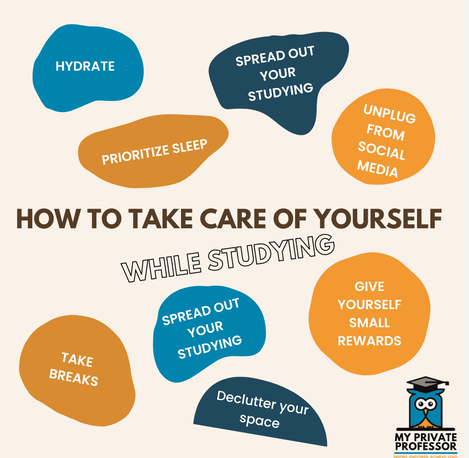
Short breaks give you an opportunity to move around, drink water, stretch, or simply rest your mind.
However, be careful with activities that can easily turn a five-minute break into an hour. Social media, gaming, and entertainment videos can make it difficult to return to studying.
A good break should refresh you rather than completely interrupt your study routine.
20. Protect Your Sleep
Sleep should not be treated as wasted study time.
Students sometimes stay awake all night before an exam because they believe that more hours of studying automatically mean better results. In reality, sleep is important for cognitive functioning and memory consolidation, and sacrificing it can make studying less effective.
Try to maintain a consistent sleep schedule during exam preparation.
Rather than studying until extremely late every night, plan your workload so that you can finish important revision earlier.
21. Eat Well and Stay Hydrated
Your study routine should also include basic physical needs.
Keep water nearby while studying and avoid relying entirely on sugary drinks or excessive caffeine.
Regular balanced meals can help you maintain energy throughout the day. If you study for several hours, take time to eat rather than continuously pushing through hunger.
A healthy routine can make it easier to maintain concentration and energy during long periods of exam preparation.
22. Manage Exam Stress
Some level of exam anxiety is normal. However, excessive stress can make it difficult to concentrate.
One way to reduce stress is to prepare early. When you know that you have already covered the syllabus and completed practice tests, the exam may feel less intimidating.
Simple strategies can also help:
- Take slow breaths
- Take short breaks
- Avoid comparing your preparation with classmates
- Focus on your own progress
- Maintain a regular sleep schedule
- Prepare your exam materials in advance
- Avoid last-minute panic
Remember that feeling nervous does not necessarily mean you are unprepared.
23. Avoid Last-Minute Cramming
Cramming involves trying to learn a large amount of material immediately before an exam.
Although students may remember some information temporarily, relying entirely on cramming is not a strong long-term learning strategy. Spaced practice is generally more effective for retention because it distributes learning across multiple sessions.
If you have already left your preparation until the last few days, focus on high-priority topics, active recall, practice questions, and past papers rather than attempting to reread every page of every textbook.
24. Create a Final Revision Strategy
During the final days before an exam, avoid trying to learn everything from scratch.
Instead, focus on:
- Important concepts
- Frequently tested topics
- Your weak areas
- Practice questions
- Past papers
- Key formulas
- Definitions
- Common mistakes
- Short summaries
Use active recall to test yourself rather than spending the entire day reading.
The final revision period should strengthen existing knowledge and identify remaining gaps.
25. Use a Simple Daily Study Routine
A practical daily routine could look like this:
Morning: Review previously learned material using active recall.
Late morning: Study a new difficult topic.
Afternoon: Complete practice questions.
Evening: Review flashcards and weak areas.
Before bed: Spend a few minutes recalling the most important information learned during the day.
You can adjust this schedule according to your school, college, university, job, and personal responsibilities.
Consistency is more important than following someone else’s exact timetable.
Common Study Mistakes Students Should Avoid
Several common habits can make studying less effective.
Only Rereading Notes
Rereading may make information feel familiar, but it does not always require you to retrieve it from memory. Combine reading with questions and self-testing.
Highlighting Everything
Highlighting can be useful for identifying key information, but highlighting entire pages does not create an effective revision strategy.
Studying Only One Subject
Focusing on one subject for an entire day may feel productive, but mixing subjects and problem types can sometimes improve learning and help you recognize different approaches.
Ignoring Practice Questions
Knowing information is different from being able to apply it. Practice questions help bridge that gap.
Studying Without a Goal
Instead of saying, “I will study biology today,” create a specific goal such as, “I will understand the circulatory system and answer 20 practice questions.”
A 7-Day Exam Preparation Example
If an exam is one week away, you can organize your preparation like this:
Day 1: Review the syllabus and identify weak areas.
Day 2: Study difficult Topic 1 and complete practice questions.
Day 3: Study difficult Topic 2 and review Topic 1 using active recall.
Day 4: Study Topic 3 and complete mixed questions from Topics 1–3.
Day 5: Complete a timed practice paper and analyze mistakes.
Day 6: Focus on weak areas and review important facts, formulas, and concepts.
Day 7: Complete light revision, review mistakes, and prepare mentally and physically for the exam.
This is only an example. Students with more preparation time should spread the same process across several weeks rather than compressing it into seven days.
How to Combine the Best Study Techniques
The strongest approach is not to depend on one technique.
Instead, combine several methods:
Step 1: Learn and understand the material.
Step 2: Create short notes or diagrams.
Step 3: Test yourself using active recall.
Step 4: Review the information using spaced practice.
Step 5: Mix related topics through interleaving.
Step 6: Solve practice questions and past papers.
Step 7: Analyze mistakes.
Step 8: Repeat the process until weak areas become stronger.
This approach combines the “when,” “how,” and “what” of effective learning. Spaced practice helps determine when to revisit material, retrieval practice makes you actively recall it, and interleaving helps you practice different concepts or problem types.
Final Thoughts
Preparing for exams successfully is not simply about spending more hours with a textbook. It is about using those hours effectively.
Techniques such as active recall, spaced repetition, practice testing, interleaving, teaching, flashcards, practice papers, and focused revision can make exam preparation more productive. Students should also protect their sleep, take appropriate breaks, manage distractions, and maintain a realistic study schedule.
The most important change is to move from passive studying to active learning. Instead of repeatedly asking, “How many pages have I read?” ask, “How much can I remember and explain without looking?”
Start early when possible, divide large topics into manageable sections, test yourself regularly, review your mistakes, and gradually increase the difficulty of your practice.