English is one of the most widely used languages for education, business, travel, technology, and international communication. Many students and beginners spend years studying English grammar and vocabulary but still feel nervous when they have to speak. They may understand what other people are saying, read articles comfortably, or write basic sentences, yet speaking can feel difficult.
The good news is that English speaking is a skill that can be developed through regular practice. You do not need to know every grammar rule or use complicated vocabulary before you start speaking. In fact, consistent speaking practice is one of the most important parts of becoming more comfortable and fluent.
The goal of speaking English is not to sound perfect. The goal is to communicate your ideas clearly, respond naturally, and become comfortable using English in real situations.
In this article, we will discuss 10 effective ways to improve your English speaking skills, whether you are a complete beginner, a student, or someone who already understands English but wants to speak more confidently.
1. Practice Speaking English Every Day
The first and most important way to improve your English speaking skills is to speak every day.
Many learners spend a lot of time reading English books, watching videos, learning vocabulary, and studying grammar. These activities can be useful, but they do not replace speaking practice. If you want to become better at speaking, you need to give yourself regular opportunities to produce English aloud.
You do not need to spend several hours speaking every day. Even 10 to 20 minutes of focused practice can be useful when you do it consistently.
For example, you can spend a few minutes talking about:
- Your daily routine
- Your family
- Your studies
- Your job
- Your hobbies
- Your favorite food
- Your plans for the weekend
- A movie or book you recently enjoyed
- Something interesting that happened during your day
Start with simple sentences. Do not worry if your grammar is not perfect.
For example:
“Today I woke up early. I had breakfast with my family. Then I studied for two hours. In the afternoon, I went outside with my friend.”
As you become more comfortable, gradually make your sentences longer and more detailed.
The important thing is consistency. Speaking for 15 minutes every day is generally more useful for building a routine than speaking for a long period only once a week.
2. Talk to Yourself in English
You do not always need a teacher, friend, or speaking partner to practise English. One of the easiest ways to practise is to talk to yourself.
Talking to yourself may feel unusual at first, but it can help you become more comfortable producing English without worrying about other people’s opinions. You can describe what you are doing, explain your plans, or discuss a topic that interests you.
For example, while preparing breakfast, you might say:
“I am making breakfast. First, I am going to make some tea. After that, I will prepare something to eat.”
You can also describe objects around you:
“There is a table in front of me. My laptop is on the table. I have a notebook next to my laptop.”
Another useful exercise is to explain your plans:
“Today I need to finish my homework. After lunch, I am going to study English. In the evening, I will watch a movie.”
This simple habit helps you practise sentence formation and word recall. Talking to yourself and narrating everyday activities are also recommended as practical ways to create speaking opportunities when you do not have a conversation partner.
3. Learn Useful Phrases Instead of Individual Words
Many English learners try to memorize long lists of vocabulary. While vocabulary is important, knowing individual words does not always mean you can use them naturally in conversation.
Instead of learning only individual words, learn complete phrases and sentence patterns.
For example, instead of memorizing the word “agree,” learn phrases such as:
- “I completely agree.”
- “I agree with you.”
- “I don’t completely agree.”
- “I agree with your point.”
Instead of learning only “opinion,” learn:
- “In my opinion…”
- “What do you think about…?”
- “From my point of view…”
Instead of memorizing “suggest,” learn:
- “I would suggest…”
- “Can I suggest something?”
- “I suggest that we…”
These phrases can become ready-to-use building blocks during conversations.
This approach also makes speaking faster because you do not have to construct every sentence word by word. Learning common language chunks can help learners produce speech more naturally and reduce hesitation.
Try to learn five useful phrases each week and use each phrase several times in your own sentences.
4. Use the Shadowing Technique
Shadowing is a popular technique for improving pronunciation, rhythm, intonation, and speaking fluency.
The basic idea is simple: listen to an English speaker and repeat what they say as closely as possible, almost at the same time.
You can use:
- English podcasts
- Short videos
- Interviews
- Educational recordings
- Movies and television programs
- English learning audio
Start with a short recording of around 30 seconds to one minute.
First, listen carefully and try to understand the meaning. Then play the recording again and repeat along with the speaker.
Pay attention to:
- Pronunciation
- Word stress
- Sentence rhythm
- Intonation
- Pauses
- Speaking speed
Do not focus only on individual words. Try to copy the way the speaker connects words and expresses complete sentences.
For example, if a speaker says:
“I’m looking forward to meeting you.”
Try to reproduce the entire sentence naturally rather than repeating each word separately.
Shadowing can be especially useful for learners who understand English but feel that their spoken English sounds slow or unnatural. It is also a practical solo exercise because it does not require a conversation partner.
5. Record Yourself Speaking
Recording yourself is another highly effective way to improve English speaking.
Many learners do not notice their speaking problems while they are talking. They may use the same filler words repeatedly, pause too often, pronounce certain words incorrectly, or speak more slowly than they realize.
Your phone can become a simple speaking practice tool.
Choose a topic and record yourself speaking for two minutes.
For example:
Topic: My Favorite Hobby
Talk about:
- What your hobby is
- When you started it
- Why you enjoy it
- How often you do it
- What you have learned from it
After recording, listen to yourself carefully.
Ask:
- Did I speak clearly?
- Where did I hesitate?
- Did I repeat the same words?
- Did I use complete sentences?
- Which words were difficult to pronounce?
- Did I speak too quickly or too slowly?
- Did I use unnecessary filler words?
Then record yourself again and try to improve one or two specific problems.
Do not try to fix everything at once. Focus on small improvements.
For example, if you notice that you frequently say “um” or “uh,” practise pausing silently instead. If pronunciation is your main problem, choose a few difficult words and practise them separately.
Self-recording provides useful feedback because you can hear aspects of your speaking that may be difficult to notice during a live conversation.
6. Think in English Instead of Translating Everything
One common reason English learners hesitate is that they first think in their native language and then translate their thoughts into English.
For example, a learner may think:
Native language → Translate → English sentence → Speak
This process can take time, especially when the person is trying to have a real-time conversation.
Instead, gradually train yourself to think directly in English.
Start with very simple thoughts.
When you wake up, think:
“I need to get ready.”
When you are hungry:
“I want something to eat.”
When you see the weather:
“It looks cloudy today.”
When you are studying:
“I need to finish this chapter.”
You do not need to think in advanced English. Start with basic sentences and gradually increase their complexity.
You can also mentally describe your surroundings throughout the day.
For example:
“I am walking to the market. There are several people on the road. The weather is warm today. I need to buy some groceries.”
This exercise helps reduce dependence on word-for-word translation and encourages faster English sentence formation.
7. Improve Your Listening Skills
Good speaking and good listening are closely connected.
When you listen to English regularly, you become familiar with pronunciation, sentence structures, vocabulary, expressions, rhythm, and natural conversation patterns.
Try to listen to English every day.
You can choose content that matches your level, such as:
- Beginner English videos
- Short educational videos
- Podcasts for learners
- Interviews
- Audiobooks
- English news
- Television programs
- Movies
Do not worry about understanding every single word.
Instead, focus on understanding the overall message and noticing how people communicate.
For example, when listening to a conversation, notice phrases such as:
“What do you mean?”
“That sounds interesting.”
“I’m not sure about that.”
“Could you explain that again?”
“What do you think?”
These expressions are useful in real conversations.
If the material is difficult, choose shorter recordings and listen to them several times. Repeated exposure can help you become more familiar with the way English sounds.
8. Find Opportunities to Speak With Other People
Speaking with other people is essential because real conversations require you to listen, respond, ask questions, explain ideas, and react naturally.
If possible, find someone who is also learning English or a person who is comfortable speaking English.
You can practise with:
- Friends
- Classmates
- Teachers
- Colleagues
- Language exchange partners
- Online study groups
- English conversation communities
You can begin with simple conversations.
For example:
Person A: “What did you do today?”
Person B: “I went to college in the morning. After class, I studied at the library.”
Then ask follow-up questions:
“What did you study?”
“How long were you at the library?”
“Did you enjoy your class?”
This helps you learn how to continue conversations rather than simply answer questions.
If you make mistakes, do not stop speaking completely. Mistakes are a normal part of learning a language. The goal is to communicate your message and gradually improve accuracy.
If you have access to an experienced teacher or tutor, feedback can be especially helpful because they can identify pronunciation, grammar, and vocabulary problems that you may not notice yourself.
9. Focus on Pronunciation, Not Just Grammar
Grammar is important, but speaking clearly also requires attention to pronunciation.
You do not need to copy a particular accent perfectly. The main goal is to make your English easy for other people to understand.
Pay attention to commonly difficult areas such as:
- Word endings
- Long and short vowel sounds
- “th” sounds
- Word stress
- Sentence stress
- Connected speech
- Intonation
For example, English speakers do not always pronounce every word with equal emphasis. Some words receive stronger stress than others.
Listen to native or highly proficient English speakers and notice which parts of sentences sound stronger.
You can improve pronunciation through repetition.
Choose five difficult words and:
- Listen to the pronunciation.
- Repeat the word slowly.
- Repeat it at a natural speed.
- Put it into a sentence.
- Record yourself.
- Compare your pronunciation with the original.
Do this regularly rather than trying to change your pronunciation in one day.
10. Build Confidence by Speaking Without Fear of Mistakes
One of the biggest barriers to improving English speaking is fear.
Some learners are afraid that other people will laugh at them because of their grammar, pronunciation, or accent. As a result, they avoid speaking.
This creates a difficult cycle:
Fear → Less speaking → Less practice → More hesitation → More fear
You can break this cycle by accepting that mistakes are part of the learning process.
Your first goal should not be perfect English. Your first goal should be communication.
For example, instead of staying silent because you cannot remember the exact word, explain the idea in another way.
If you forget the word “umbrella,” you might say:
“The thing we use when it is raining.”
This is an important communication skill called paraphrasing.
Similarly, if you forget a complicated word, use a simpler one.
Instead of:
“I was extremely exhausted.”
You can say:
“I was very tired.”
Simple English is still English.
As your confidence grows, you can gradually use more advanced vocabulary and sentence structures.
A Simple Daily English Speaking Routine
The techniques above become more effective when you turn them into a daily routine.
Here is a simple 30-minute plan:
5 Minutes: Vocabulary and Phrases
Learn three to five useful phrases.
Say each phrase aloud several times and create your own sentences.
10 Minutes: Listening and Shadowing
Choose a short English recording. Listen carefully and repeat the speaker’s sentences.
Focus on pronunciation, rhythm, and intonation.
10 Minutes: Free Speaking
Choose one topic and speak without preparing a full script.
For example:
- My family
- My studies
- My hometown
- My favorite food
- My future goals
- My favorite movie
- A memorable day
Try to keep speaking even when you make small mistakes.
5 Minutes: Recording and Review
Record yourself or review what you practised.
Choose one weakness to improve tomorrow.
This type of consistent routine is more practical than trying to memorize large amounts of English without using them. Regular speaking practice is repeatedly emphasized as an important part of developing spoken fluency.
Common Mistakes English Learners Should Avoid
While improving your speaking skills, try to avoid several common mistakes.
Trying to Speak Perfectly
Waiting until your English is perfect will prevent you from getting enough practice.
Start speaking with the English you already know.
Memorizing Too Many Words
Learning hundreds of words without using them will not automatically make you a better speaker.
Learn useful words and phrases and use them repeatedly.
Studying Only Grammar
Grammar is useful, but speaking requires active practice. Balance grammar study with listening and speaking.
Speaking Only Once a Week
Infrequent practice makes it difficult to build confidence and automaticity.
Try to speak English every day, even for a short period.
Comparing Yourself With Fluent Speakers
Do not compare your first attempts with someone who has been speaking English for years.
Compare your current ability with your own ability from one month ago.
How Long Does It Take to Improve English Speaking?
There is no fixed amount of time required to become a better English speaker. Progress depends on your current level, practice routine, exposure to English, motivation, and the amount of speaking you do.
However, regular practice can make a noticeable difference over time.
Instead of asking:
“How quickly can I become fluent?”
Ask:
“How consistently can I practise today?”
If you speak English for 15 to 30 minutes every day, listen regularly, learn useful phrases, and actively work on your weaknesses, you can gradually become more comfortable and effective.
Progress may seem slow at first. You might notice only small changes from one day to the next. However, after several weeks or months, the difference can become much more noticeable.
Final Thoughts
Improving English speaking skills does not require expensive equipment, complicated study methods, or perfect grammar. What you need most is consistent practice and a willingness to speak even when you make mistakes.
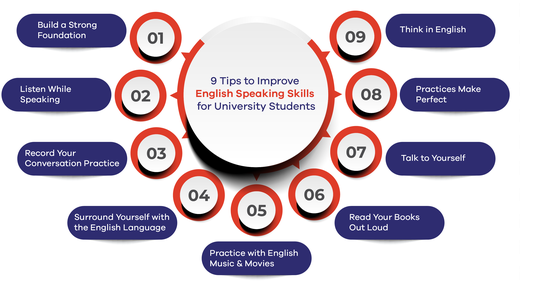
The 10 effective ways to improve your English speaking skills are:
- Practice speaking English every day.
- Talk to yourself in English.
- Learn useful phrases instead of individual words.
- Use the shadowing technique.
- Record yourself speaking.
- Think in English instead of translating everything.
- Improve your listening skills.
- Find opportunities to speak with other people.
- Focus on pronunciation as well as grammar.
- Build confidence by speaking without fear of mistakes.
The most important lesson is simple: you improve your speaking by speaking. Reading and listening can provide valuable knowledge, but you need to actively use that knowledge in conversation.
Start with just 10 minutes today. Choose a simple topic, speak aloud, record yourself if possible, and review your performance. Tomorrow, do it again.