Learning a new language can be exciting, but building a strong vocabulary is often one of the biggest challenges. Grammar helps you understand how a language works, while vocabulary gives you the words you need to communicate. Without enough vocabulary, it can be difficult to understand conversations, read confidently, express your ideas, or participate in everyday situations.
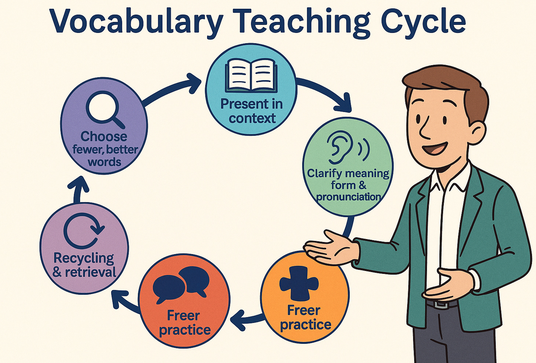
The good news is that you do not need to memorize thousands of words at once. A strong vocabulary develops gradually through consistent exposure, active practice, repetition, and real-world use. Research on second-language vocabulary learning supports techniques such as spaced practice and retrieval practice, which can help learners retain words more effectively over time.
Whether you are learning English, Spanish, French, German, Arabic, Japanese, or another language, the following strategies can help you build a useful and lasting vocabulary.
1. Start With the Most Useful Words
One of the biggest mistakes language learners make is trying to memorize random vocabulary. Instead, begin with words that are relevant to your daily life.
Think about the situations in which you are most likely to use the language. If you are learning a language for travel, focus on words related to transportation, hotels, restaurants, directions, shopping, and basic conversations. If you are learning for work, concentrate on professional vocabulary, emails, meetings, presentations, and workplace communication.
For general language learning, prioritize common words such as:
- People and family
- Food and drinks
- Time and dates
- Numbers
- Common verbs
- Places
- Daily activities
- Emotions
- Household objects
- Travel
- School and work
Learning useful words first gives you immediate opportunities to practice them.
2. Learn Words in Context
Memorizing a word and its translation is useful, but learning the word in context is usually much more powerful.
For example, instead of simply memorizing:
“Borrow = take something temporarily”
learn it in a sentence:
“Can I borrow your pen?”
The sentence helps you understand how the word is naturally used. It also gives your brain additional information about grammar, pronunciation, and common word combinations.
Context can make unfamiliar words easier to understand, while active retrieval can help strengthen later retention. Research has found that vocabulary practice involving retrieval can improve later recall compared with simply encountering words in context.
Whenever you learn a new word, try to create at least one simple sentence with it.
3. Use Spaced Repetition
One of the most effective ways to remember vocabulary is to review words at gradually increasing intervals.
Instead of studying the same 30 words repeatedly for two hours on one day, review them for a few minutes across several days.
For example:
- Day 1: Learn the words
- Day 2: Review them
- Day 4: Review again
- Day 7: Review again
- Day 14: Test yourself
- Day 30: Review difficult words
This approach is called spaced practice or spaced repetition.
Research on second-language vocabulary has found advantages for spaced learning, particularly for longer-term retention.
You can use flashcards, a notebook, or a vocabulary-learning app to organize your reviews.
4. Practice Active Recall
Simply looking at a word repeatedly can create the feeling that you know it. However, recognizing a word is not the same as being able to produce it yourself.
Active recall means trying to remember the word without immediately looking at the answer.
For example, if you see the English word “expensive,” cover its translation and ask yourself:
“What does expensive mean?”
Or go in the opposite direction:
“What is the English word for something that costs a lot of money?”
Trying to retrieve the answer forces your brain to actively access the information.
Retrieval practice is an important component of effective vocabulary learning, and research suggests that combining retrieval with spaced practice can improve long-term retention.
5. Keep a Personal Vocabulary Notebook
A vocabulary notebook can become one of your most useful language-learning tools.
Whenever you encounter a useful new word, write it down. But avoid writing only the word and translation.
A better format is:
Word: improve
Meaning: to make something better
Example: I want to improve my English.
Related words: improvement, improved
Personal sentence: I want to improve my speaking skills.
This approach gives you more information about the word and encourages you to use it actively.
You can organize your notebook into categories such as food, travel, work, emotions, education, technology, and everyday conversation.
6. Learn Word Families
Many languages contain groups of related words. Learning these together can help you expand your vocabulary more efficiently.
For example, in English:
- Create
- Creation
- Creative
- Creativity
- Creatively
- Creator
Instead of learning each word as a completely separate item, understand the relationship between them.
Word families also help you recognize unfamiliar words when reading.
However, do not try to memorize every possible form immediately. Start with the most common forms and gradually expand your knowledge.
7. Learn Phrases Instead of Individual Words
Native speakers do not communicate by selecting isolated words one at a time. They frequently use common combinations of words and phrases.
For example, instead of learning only the word “decision,” learn expressions such as:
- Make a decision
- Reach a decision
- Important decision
- Difficult decision
- Final decision
Similarly, instead of learning only “interested,” learn:
- Interested in
- Very interested in
- Become interested in
- Interested in learning
These combinations help you sound more natural and reduce the amount of mental effort required when speaking.
8. Read Every Day
Reading is one of the easiest ways to increase vocabulary naturally.
You do not have to start with difficult novels. Choose material that matches your current level.
Beginners can read:
- Short stories
- Simple news articles
- Children’s books
- Beginner reading passages
- Graded readers
- Short online articles
Intermediate learners can move toward:
- Blogs
- Magazines
- Longer stories
- General news
- Popular nonfiction
Advanced learners can read novels, academic materials, professional articles, and other authentic content.
When you encounter an unfamiliar word, do not automatically stop and translate every word. First try to understand its meaning from the surrounding sentence.
9. Use New Words Immediately
One of the most important rules for vocabulary learning is simple: use new words as soon as possible.
If you learn the word “confident,” try to say:
“I feel confident today.”
If you learn “recommend,” say:
“Can you recommend a good book?”
If you learn “appointment,” create a sentence about making an appointment.
The more actively you use a word, the more familiar it becomes.
Try to use new vocabulary in speaking, writing, texting, journaling, or conversations with language partners.
10. Practice Speaking Regularly
Vocabulary becomes much more valuable when you can use it in real conversations.
You do not need to wait until your vocabulary is perfect before speaking. In fact, speaking is one of the best ways to discover which words you actually need.
During a conversation, you may realize that you do not know how to describe your job, explain a problem, talk about your weekend, or express an opinion.
Write down those missing words after the conversation and learn them.
This creates a personalized vocabulary list based on your actual communication needs.
11. Listen to Native Speakers
Listening exposes you to vocabulary in its natural environment.
You can listen to:
- Podcasts
- Interviews
- Movies
- TV programs
- YouTube videos
- Audiobooks
- Music
- Everyday conversations
At first, you may understand only a small percentage. That is normal.
Start with slower content or material designed for language learners. As your listening ability improves, gradually move toward authentic content.
Pay attention not only to individual words but also to pronunciation, expressions, sentence patterns, and frequently repeated phrases.
12. Use Subtitles Strategically
Subtitles can be extremely helpful when watching videos in your target language.
If possible, try using subtitles in the language you are learning rather than relying entirely on subtitles in your native language.
For example, if you are learning English, watch an English video with English subtitles.
When you hear a word and see it written at the same time, you connect its sound with its spelling and meaning.
You can also watch a short section several times:
- Watch without subtitles.
- Watch with subtitles.
- Identify unfamiliar vocabulary.
- Review the new words.
- Watch again without subtitles.
This turns entertainment into active language practice.
13. Learn Through Flashcards
Flashcards can be useful when they are used correctly.
A basic flashcard might contain:
Front: “What is the English word for ‘khubsurat’?”
Back: “Beautiful”
You can make flashcards yourself or use a digital flashcard system.
However, do not spend all your time simply flipping cards and rereading answers. Try to recall the answer before checking the back.
You can make flashcards more useful by including:
- Word
- Meaning
- Example sentence
- Pronunciation
- Picture
- Related word
- Common phrase
This creates stronger connections around the vocabulary item.
14. Use Pictures and Visual Associations
Pictures can make vocabulary easier to remember, especially for concrete objects.
For example, when learning the word “apple,” associate the word with an image of an apple.
For abstract vocabulary, create a mental image or situation.
For the word “nervous,” imagine yourself preparing for an important presentation.
For “celebrate,” imagine a birthday party.
The goal is to connect the new word with an idea or experience rather than relying exclusively on translation.
15. Create Your Own Example Sentences
Writing your own sentences is a powerful way to turn passive vocabulary into active vocabulary.
Suppose you learn the word “opportunity.”
Instead of only memorizing its definition, write:
“Learning a new language can create new opportunities.”
Then write another:
“I had an opportunity to speak with a native speaker.”
Creating personal examples requires you to think about how the word works, which can make it easier to remember.
16. Group Vocabulary by Topic
Organizing vocabulary by topic can make learning more manageable.
For example, create a “Travel” vocabulary group:
- Airport
- Passport
- Ticket
- Luggage
- Hotel
- Reservation
- Departure
- Arrival
- Destination
- Boarding
Then create another group for “Food”:
- Breakfast
- Lunch
- Dinner
- Restaurant
- Menu
- Vegetable
- Fruit
- Delicious
- Spicy
- Sweet
Topic-based learning is particularly useful when preparing for a specific situation, such as travel, school, work, or an examination.
17. Avoid Learning Too Many Words at Once
Trying to learn 100 new words every day may sound impressive, but it can quickly become overwhelming.
A smaller number of words learned well is usually more useful than a huge list that you quickly forget.
Start with perhaps 5–15 meaningful words per day, depending on your schedule and level.
The exact number is less important than consistency.
If you learn 10 words per day and regularly review them, you could encounter hundreds of vocabulary items over several months.
18. Focus on Difficult Words
Not every word requires the same amount of attention.
Some words will become familiar after one or two encounters. Others may continue to disappear from your memory.
Keep track of difficult words and review them more frequently.
For example, divide vocabulary into three groups:
Easy: I remember this immediately.
Medium: I sometimes forget it.
Difficult: I almost always forget it.
Spend less time on easy words and more time on difficult ones.
This makes your study sessions more efficient.
19. Learn Synonyms and Opposites Gradually
Once you know basic vocabulary, start connecting words with similar and opposite meanings.
For example:
Happy
- Glad
- Cheerful
- Pleased
Opposites
- Sad
- Unhappy
- Miserable
Similarly:
Big
- Large
- Huge
- Enormous
Opposites
- Small
- Tiny
Learning relationships between words can help you express yourself more precisely.
However, remember that synonyms are not always interchangeable. Learn how each word is normally used rather than assuming that all words with similar meanings work in exactly the same situations.
20. Make Vocabulary Part of Your Daily Routine
Consistency matters more than occasional long study sessions.
A simple daily routine could look like this:
Morning: Learn 5–10 new words.
Afternoon: Use two or three words in sentences.
Evening: Review older vocabulary.
Before bed: Listen to or read something in the target language.
This routine may take only 20–30 minutes, but doing it regularly can produce significant progress over time.
Research comparing learning conditions has repeatedly highlighted the value of distributing vocabulary practice rather than relying only on concentrated study sessions.
21. Think in the New Language
As your vocabulary grows, try to reduce your dependence on translation.
For example, when you see a chair, instead of thinking:
“Chair → meri zaban mein meaning → English”
try to connect the object directly with:
Chair
Similarly, when you feel hungry, try to think:
“I am hungry.”
Direct associations can help you respond more naturally when speaking.
You do not need to eliminate translation completely. It is a useful tool, especially at beginner level. The goal is to gradually build direct connections between the new language and the ideas you want to express.
22. Use Technology Wisely
Language-learning apps and digital tools can make vocabulary practice easier.
You can use them for:
- Flashcards
- Spaced repetition
- Pronunciation practice
- Vocabulary quizzes
- Listening exercises
- Reading practice
- Progress tracking
However, technology should support learning rather than replace actual language use.
An app may help you memorize the word “restaurant,” but real communication requires you to understand and use phrases such as:
“Where is the nearest restaurant?”
“Can I see the menu?”
“Do you have a table available?”
Combine digital practice with reading, listening, speaking, and writing.
23. Review Vocabulary Through Different Activities
Do not always study vocabulary in the same way.
For example, if you learn the word “environment,” you might:
- Read it in an article.
- Hear it in a podcast.
- Write a sentence with it.
- Say it aloud.
- Use it in a conversation.
- Create a flashcard.
- Explain its meaning to someone else.
Using a word in different situations gives you multiple opportunities to strengthen your understanding.
At the same time, recent research suggests that practice conditions can influence vocabulary learning in complex ways, so there is no single technique that works identically for every learner or every type of vocabulary.
24. Test Yourself Regularly
Self-testing helps you discover what you actually remember.
At the end of each week, take a vocabulary test.
Write down 20 words you studied and see whether you can:
- Define them
- Translate them
- Spell them
- Pronounce them
- Use them in sentences
- Recognize them when listening
Try both directions.
For example:
New language → native language
and
Native language → new language
Producing a word yourself is often more challenging than recognizing it, so both forms of practice are useful.
25. Do Not Be Afraid of Forgetting
Forgetting is a normal part of learning a language.
You may study a word today and forget it tomorrow. That does not mean your study session was wasted.
When you encounter the word again, your brain has another opportunity to strengthen the memory.
Instead of becoming frustrated, use forgotten words as signals for review.
The goal is not to remember every word forever after the first exposure. The goal is to encounter, retrieve, use, and review vocabulary repeatedly.
26. Set Realistic Vocabulary Goals
Create goals that are measurable and achievable.
Instead of saying:
“I want to learn a lot of English vocabulary.”
set a goal such as:
“I will learn 10 useful words each weekday and review them every weekend.”
You can also set monthly goals:
- Learn 200 useful words.
- Read one beginner-level book.
- Watch four videos in the target language.
- Have four conversations with a language partner.
- Write eight short journal entries.
Specific goals make progress easier to track.
27. Build a Balanced Vocabulary
A strong vocabulary is not simply a large collection of difficult words.
You need different types of vocabulary, including:
Everyday vocabulary: words used in normal conversations.
Academic vocabulary: words useful for education and formal writing.
Professional vocabulary: words related to your job or industry.
Conversational expressions: phrases used naturally in speech.
Descriptive vocabulary: words that help you explain people, places, feelings, and experiences.
Focus first on everyday vocabulary and then gradually expand into specialized areas.
A Simple 30-Day Vocabulary Plan
If you want a practical starting point, follow this four-week structure.
Week 1: Basic Vocabulary
Focus on common words related to:
- Family
- Food
- Home
- Numbers
- Time
- Daily activities
Learn a small number of words each day and create simple sentences.
Week 2: Everyday Communication
Focus on:
- Greetings
- Questions
- Directions
- Shopping
- Transportation
- Common expressions
Practice speaking these words and phrases aloud.
Week 3: Reading and Listening
Start reading short texts and watching simple videos.
Write down useful vocabulary that appears repeatedly.
Do not try to record every unfamiliar word. Focus on words that are common, useful, or important for understanding the material.
Week 4: Active Use
Focus on using everything you have learned.
Write short paragraphs, speak with a language partner, describe your day, and test yourself.
At the end of the month, review the vocabulary you learned and identify the words that still need additional practice.
Common Vocabulary Learning Mistakes to Avoid
Building vocabulary becomes easier when you avoid inefficient habits.
Memorizing Huge Word Lists
Large lists can quickly become overwhelming. Prioritize useful vocabulary.
Studying Without Review
Learning a word once does not guarantee long-term memory. Schedule regular reviews.
Only Recognizing Words
Being able to recognize a word is different from being able to use it. Practice producing vocabulary.
Ignoring Pronunciation
A word is not truly useful if you cannot pronounce it well enough to be understood.
Learning Without Context
Definitions alone may not show you how a word behaves in a real sentence.
Focusing Only on Difficult Words
Advanced vocabulary can be interesting, but common words usually provide greater practical value for everyday communication.
Final Thoughts
Building a strong vocabulary when learning a new language is a gradual process. You do not need to memorize thousands of words overnight. Instead, focus on learning useful vocabulary, understanding words in context, reviewing them at spaced intervals, actively recalling them, and using them in real communication.
The most effective approach combines several habits. Read regularly, listen to native or proficient speakers, practice speaking, write your own sentences, use flashcards when helpful, and keep reviewing older vocabulary. Research supports combining strategies such as spaced practice and retrieval practice rather than relying on simple repetition alone.